The PPWR: new European legislation to transform packaging
The PPWR (Packaging and Packaging Waste Regulation) is the new European regulatory framework for packaging and packaging waste. Its objective is clear: to minimise the environmental impact of packaging throughout its life cycle.
To achieve this, the PPWR establishes several key principles:
- Eliminating substances of concern
- Promoting and ensuring recyclability
- Incorporating recycled materials into plastic packaging
- Increasing the use of ‘bio-based plastics’
- Require compostable packaging in specific cases
- Minimise packaging and empty space.
Unlike a directive, a European regulation applies directly across all Member States. This harmonisation aims to provide a common framework for all economic operators whilst accelerating the transition to a more circular economy.


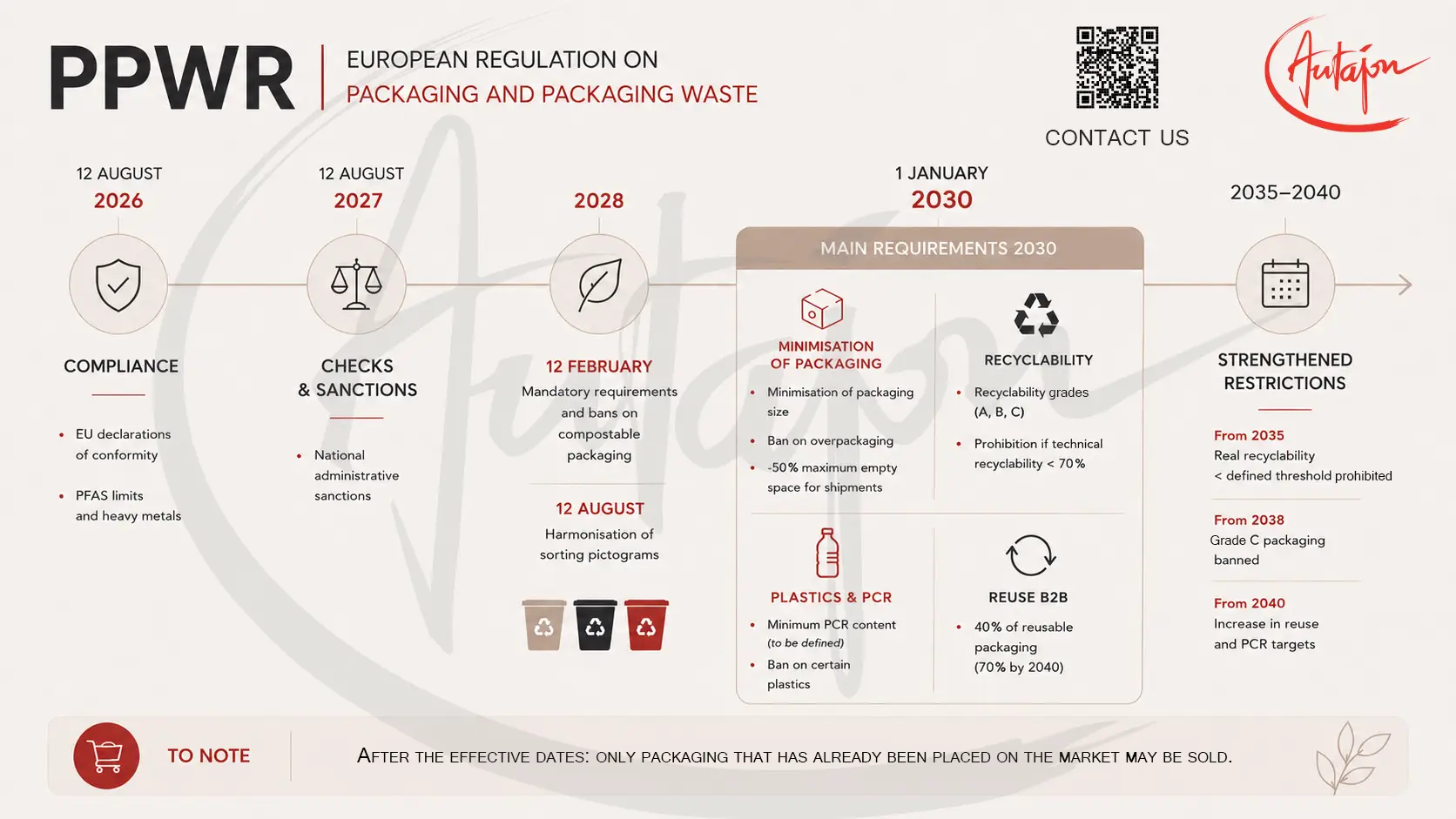
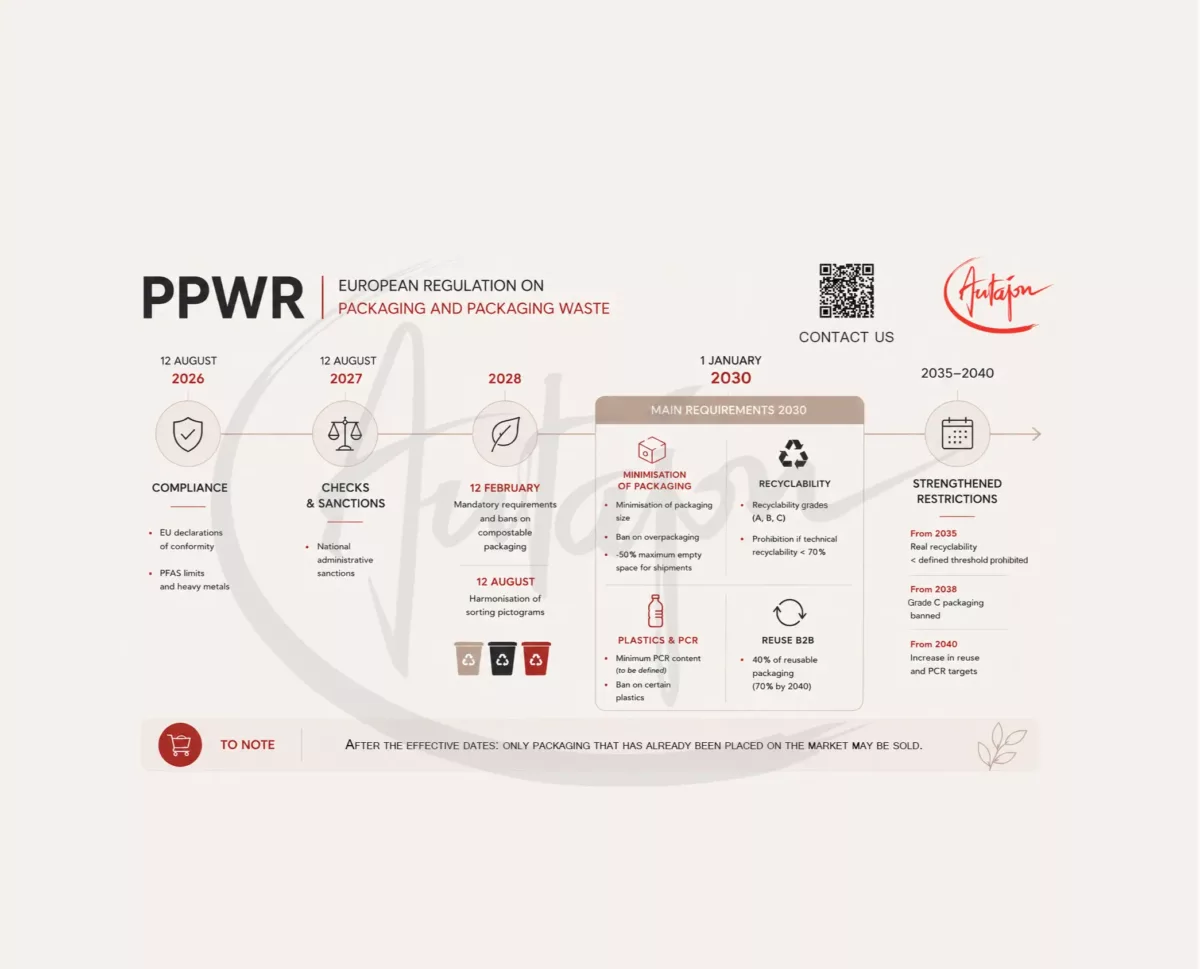
12 August 2026: the first compliance obligations
The first major milestone of the PPWR will take place on 12 August 2026.
From this date, companies must be able to demonstrate that their packaging complies with the requirements set out in the regulations. This deadline marks the start of a more structured approach to regulatory compliance for packaging.
In particular, manufacturers will need to be able to provide EU declarations of conformity to demonstrate that their packaging meets the applicable requirements. Under the PPWR, the term ‘manufacturer’ refers to the company that commissions the manufacture of and markets the packaging, i.e. the brand owner or the contracting party.
Packaging intended for food contact will be subject to particular scrutiny, notably with the introduction of a limit on PFAS (per- and polyfluoroalkyl substances). A limit on heavy metals will also be introduced for all packaging.
For businesses, this initial deadline already sends a strong signal: a precise understanding of the materials used and their regulatory compliance is becoming a strategic priority. As a supplier, Autajon has also begun this compliance work with its own raw material suppliers. This approach enables us to provide our customers, on request, with the necessary certificates to help them meet their regulatory obligations.
12 August 2027: Introduction of administrative penalties.
One year later, the regulatory framework enters a new phase. From 12 August 2027, Member States will be required to implement the monitoring mechanisms set out in the regulations. Administrative penalties may be imposed in the event of non-compliance with obligations. This date is particularly significant as it marks the transition from a proactive approach to one of effective enforcement. Companies will then be required to demonstrate their compliance in a documented and verifiable manner.
2028: compostability and standardisation of recycling symbols.
The year 2028 marks a new stage in the roll-out of the PPWR.
The first change concerns so-called ‘compostable’ packaging: the bans and requirements applicable to it. Currently, there are two categories: industrial and domestic compostability. From 12 February 2028 onwards, only ‘industrially compostable’ packaging will be permitted, and this will apply solely to products intended to end up as bio-waste (labels for fruit and vegetables, tea bags, etc.). This type of packaging will be prohibited for all other products.
The second change will have a major impact on all packaging (excluding returnable packaging). From August 2026, the European Parliament is expected to formalise the future harmonised sorting logos and pictograms. Companies will then have 24 months to bring their packaging into compliance, with compliance required by 12 August 2028 at the latest.
This change is primarily aimed at harmonising the pictograms used on packaging with those found at collection points, in order to make them easier to identify and improve consumers’ understanding of recycling guidelines. For brands operating internationally, this harmonisation also represents an opportunity for simplification.


1 January 2030: the deadline that will bring about lasting change to the market.
1 January 2030 is undoubtedly the most important date in the regulations. It is on this date that several key requirements will come into force simultaneously.
Reduction in packaging
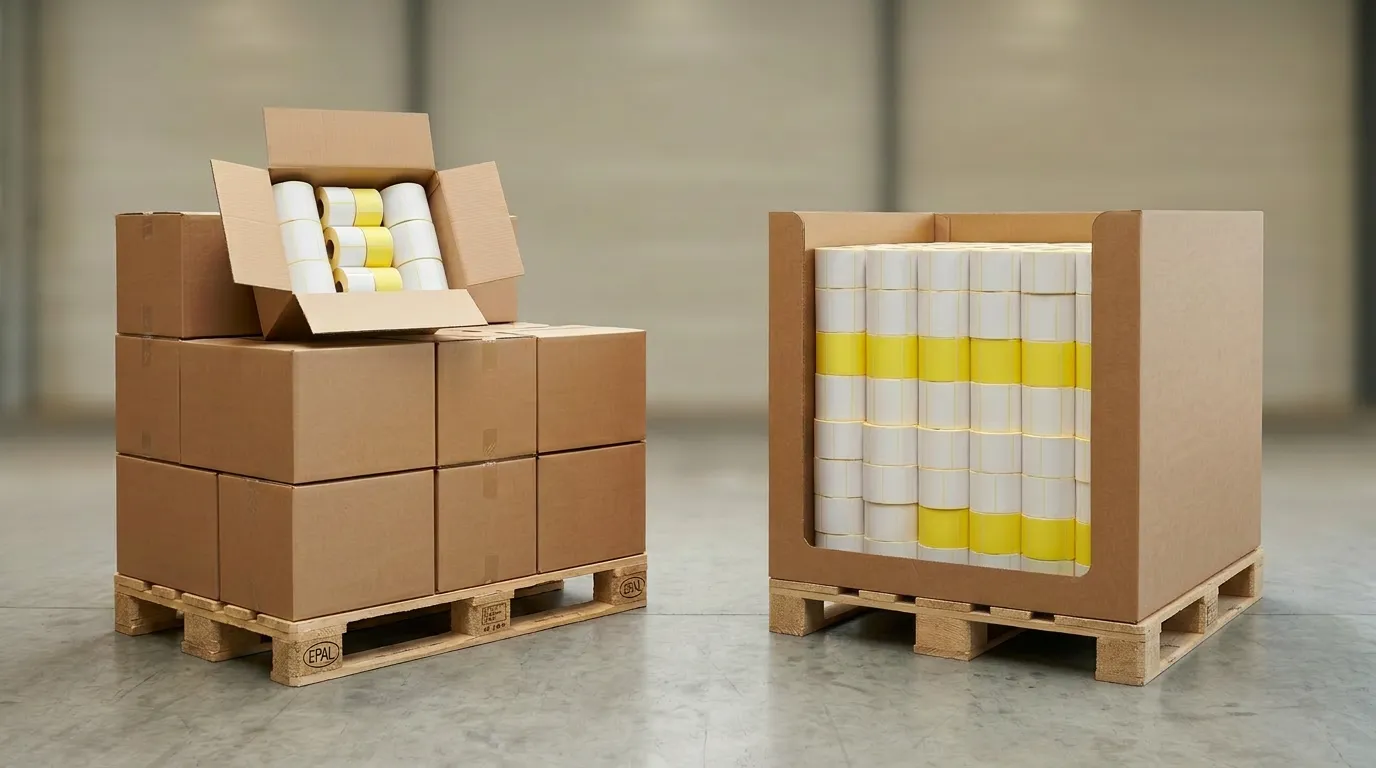
The PPWR introduces a fundamental principle: all packaging must be designed with a view to minimisation. The aim is to reduce unnecessary volumes and over-packaging that serve no essential technical or commercial purpose.
This requirement is reflected, in particular, in new rules aimed at limiting excessive empty space. For example, a ban on misleading packaging and a limit of no more than 50 per cent empty space for delivery packaging will be introduced.
Companies will have to be able to justify the dimensions and design of their packaging.
Recyclability is becoming an essential criterion.
Today, much packaging is labelled as ‘recyclable’, but in practice it is not always actually recycled, as it is not properly handled by existing sorting and recycling systems.
The PPWR will take this approach a step further.
Recyclability grades A, B and C will be introduced to assess the actual performance of packaging. The focus is no longer simply on whether packaging is technically recyclable, but on whether it can actually be collected, sorted and recycled under realistic industrial conditions.
- Grade A: ≥ 95%
- Grade B: ≥ 80%
- Grade C: ≥ 70%
From 2030, packaging with a technical recyclability rate of less than 70 per cent will be banned in the European Union.
This development will particularly favour packaging designed from a single material and compatible with existing recycling streams.
Plastic packaging at the heart of the PPWR regulation
The European regulation also provides for the introduction of a minimum proportion of PCR (Post-Consumer Recycled) plastic in plastic packaging. The aim is to support the development of the circular economy by reincorporating plastic waste into new packaging and to reduce dependence on virgin fossil-based materials.
At the same time, certain categories of plastic packaging will be subject to restrictions or bans, in particular single-use plastic packaging for foodstuffs in the hospitality sector, as well as group-packaging used for bundling at points of sale. This development is prompting many brands to start exploring alternatives to plastic packaging now and to turn to cardboard packaging, a more easily recyclable solution.
The growth of reuse in the B2B sector.
The PPWR also sets ambitious targets for reuse, particularly in B2B flows
The regulation provides for significant changes regarding the reuse of packaging, particularly transport packaging such as pallets, crates, bins or drums used between businesses.
The aim is to encourage the reuse of this packaging used in B2B contexts rather than its systematic replacement after a single use. From 2030, 40 per cent of the packaging concerned in these flows must be reusable.
2035–2040: stricter restrictions.
The PPWR does not end in 2030. The regulation provides for a gradual tightening of requirements in the years that follow. From 2035, packaging that is not ‘economically’ recyclable will no longer be permitted on the European market.
Until 2040, new requirements will then come into force gradually, notably concerning:
- In 2038, Grade C recyclability packaging will be banned
- In 2040, the minimum reuse thresholds for B2B will be raised to 70%
- In 2040, the rates of post-consumer recycled content (PCR) in plastic packaging will also increase to 65 per cent (excluding beverage bottles and packaging in sensitive contact with food).
This phased approach gives manufacturers, as defined by the PPWR, time to adapt their packaging in anticipation of future regulatory requirements. It also enables packaging manufacturers to support them in this process by developing solutions that meet the new expectations of the market and the regulations. The packaging of the future will no longer simply have to showcase the product, but must also be fully integrated into a circular economy approach.
Why do organizations need to plan ahead now?
Whilst some deadlines may still seem a long way off, the decisions taken today will have a direct impact on the future compliance of packaging.
The dates set out below correspond to the various stages of the PPWR’s entry into force. They mark the point from which the relevant requirements become applicable to packaging placed on the European market. For manufacturers and distributors, these deadlines are therefore the cut-off dates they must plan for to ensure their packaging complies; otherwise, it will no longer be permitted to be sold.
Developing a new packaging project often takes several weeks or even several months. Between design, technical validation, testing and market launch, development cycles can be complex. Waiting until the very last minute to consider recyclability, material reduction or eco-design could result in significant costs and limit opportunities for optimisation.
Conversely, planning ahead for PPWR requirements with Autajon allows you to draw on the expertise of a supplier of cardboard packaging and labels, and its design offices:
- to incorporate future requirements right from the design phase
- to avoid successive redesigns
- to optimise the recyclability and environmental performance of your packaging
- to meet the growing expectations of consumers and retailers
- to safeguard the investments made today.
Turning regulatory constraints into opportunities.
Beyond compliance, the PPWR also represents an opportunity for innovation. Reducing plastic, simplifying packaging structures, improving recyclability, optimising formats and developing single-material solutions: these are all ways of balancing environmental performance, consumer experience and brand enhancement.
At Autajon, we support our clients through this transition by developing bespoke packaging solutions, designed to address their challenges as well as current and future regulatory requirements. Because compliant packaging need not sacrifice its personality, we design solutions that combine technical performance, brand identity and consumer experience.
Planning for the future today means designing the high-performance packaging of tomorrow.