Driven by the decisive leadership of its President, Gérard Autajon, the pursuit of environmental performance has supported the Autajon Group’s development for over 20 years. To achieve this, we rely in particular on the 3R Policy: Reduce, Reuse and Recycle.
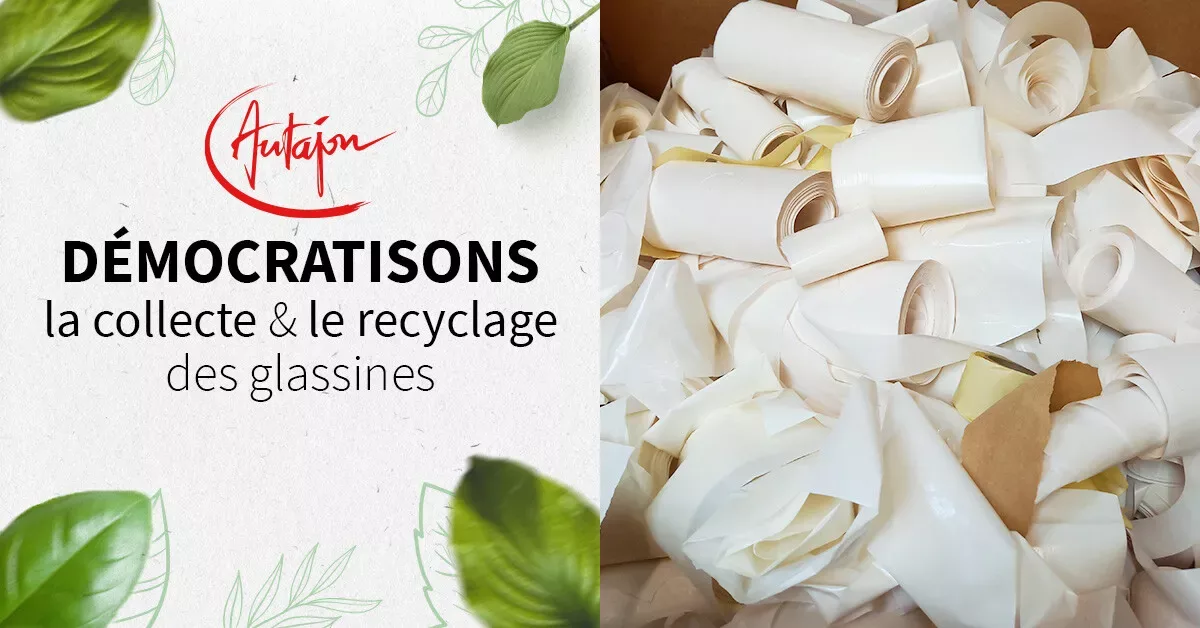
This policy naturally applies to our own consumption and production, but also to the support we provide to our customers. Since 2018, AUTAJON has been actively involved in the recycling of glassine, which is ultimately the main waste generated during label application on packaging lines.
Understanding labels and glassine
The different types of labels
Founded in 2002, our Autajon Labels Division specialises in the design and printing of labels for Wines & Spirits and mainly offers two products: wet-glue labels and self-adhesive labels.
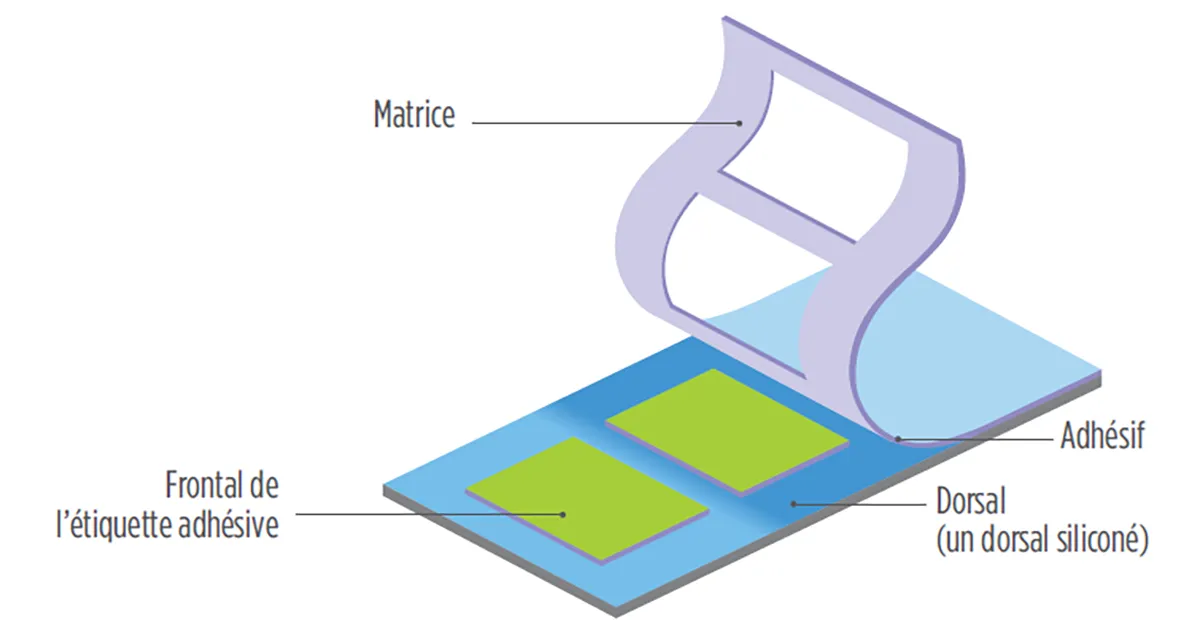
A so‑called wet-glue label must be glued at the time of application using a “wet glue”. A self‑adhesive label is made up of a printable face material, an adhesive and a backing, allowing for direct application. Historically, “traditional” wine labels were wet-glue, but since their introduction, self-adhesive solutions have steadily gained ground and are now predominant. In Europe, 80% of wine labels are self‑adhesive and only 15% are wet‑glue as of 2020 (source: AWA – Alexander Watson Associates).
Self-adhesive labels: clear advantages, but challenges for recycling
The predominance of self‑adhesive labels has also led to an increase in a new type of production waste: the backing. Once the self‑adhesive label has been removed from its liner, the backing no longer serves any purpose. There are essentially two types of backing: plastic liners (PP or PET‑based) and paper glassine.
It is estimated that paper glassine accounts for between 85% and 90% of the backings used for self‑adhesive wine labels (source: Le Vigneron Champenois). It is composed of paper and a layer of silicone that facilitates the removal and application of the label. The combination of silicone and paper makes glassine difficult to recycle and incompatible with conventional “paper / cardboard” sorting streams. This observation led to the decision to develop glassine recycling solutions.
Glassine: a major process waste to be collected and recycled
AUTAJON: a key player in glassine waste collection
In France, annual glassine consumption before 2018 was estimated at over 50,000 tonnes, of which only 5% were collected (source: UNFEA). Since 2018, Autajon has been proud to take part in an initiative designed to expand and simplify collection in order to reverse this trend.
As a printer, we produce labels in a wide variety of shapes and sizes for our customers. For our self-adhesive solutions, we estimate that the backing represents around 35% to 45% of the overall material, which ultimately becomes waste at our customers’ sites once the labels have been applied. It therefore makes perfect sense to build a bridge between customers and partners, and offer a recycling alternative to standard landfill or incineration practices.
An initiative that removes the barriers to glassine recycling
In partnership with Avery Dennison, Cycle4Green and Lenzing, the Autajon Étiquettes Épernay site helped launch a pilot programme in Champagne to collect glassine as early as 2018. This initiative delivered positive results and has since been strengthened and rolled out across France. Before that, several collection solutions existed, but they were both costly and restrictive. They required wine estates to store very large quantities of glassine and to finance its recovery.
With this programme, Autajon helps remove these constraints by offering a solution that benefits everyone, and above all the environment. The programme is structured around three collection channels:
- Estates and contract packers that already store very large quantities of glassine work directly with recycling partners.
- Autajon provides larger customers with dedicated cardboard containers to store glassine. Once full, these are collected and consolidated at our own production site.
- For smaller customers, we collect glassine directly when delivering new label reels and add it to our own collection.
Autajon undertakes to store up to 12 pallets at a single production site, equivalent to 6 tonnes of glassine, before they are collected by our partners. This initiative delivers a turnkey customer service that removes constraints while supporting the growth of glassine collection and recycling. We also add our own production waste to the stream: excess matrix waste (the area between the label and the edge of the reel), which, although it represents only a small share of the glassine collected, still contributes to overall volume.
Positive results: more than 55 tonnes of glassine collected by AUTAJON in Champagne between 2019 and 2021
This initiative enabled the Autajon Étiquettes Épernay pilot site alone to collect and therefore recycle 9 tonnes of glassine in 2019, 11 tonnes in 2020 and 35 tonnes in 2021. In other words, volumes almost quadrupled in just two years in Champagne. These results were made possible thanks to the commitment of the Autajon teams in rolling out and delivering this service, as well as the strong enthusiasm of customers for a more responsible approach.
Our customers are essential to the success of this initiative. The Maison Bollinger, for instance, has been actively involved in the collection and consolidation of glassine since the launch of our service.
Advancing the development of glassine recycling
Giving glassine a second life
Once collected by Autajon and recovered by our partners, glassine is reintroduced into a dedicated recycling process. First, the paper and silicone are separated. The paper component is then recycled to produce new paper pulp, which is in turn reused to manufacture labels. This collection system therefore contributes to a circular economy where waste is given a second life.
Autajon: expanding glassine recycling across markets
This glassine collection and recycling service is widely acclaimed by the Champagne‑based customers of Autajon Étiquettes Épernay. These positive and encouraging results are driving us to roll out this type of service across all sites in our Autajon Étiquettes and Autajon Labels Divisions. Today, 50% of our French label production sites already offer or are developing a similar solution.
Contact us to learn more about our glassine collection programmes at:
Autajon Étiquettes Épernay, Autajon Étiquettes Méditerranée and Autajon Étiquette Bourgogne for Wines & Spirits;
Autajon Labels Lorient and Autajon Labels Rouen for the food and pharmaceutical sectors.